Quality Engineering as a Service (QEaaS) Model
The Quality Engineering as a Service (QEaaS) model represents a fundamental shift in how quality is owned, measured, and delivered across our engineering organisation. Rather than acting as a downstream gatekeeper, the Quality Engineering (QE) team operates as a platform enablement team.
In this model, Product Developers own quality, including the writing and execution of automated tests. The QE team is responsible for providing the self-service tooling, frameworks, pipelines, and guidance that make high-velocity testing possible.
1. The Vision: From Gatekeepers to Platform Enablers
Traditionally, QA/QE departments operated as a final bottleneck in the Software Development Life Cycle (SDLC): code was written, thrown "over the wall" to QE, and tested manually or via brittle end-to-end (E2E) automation suites. This approach is incompatible with modern Trunk-Based Development and continuous deployment models.
Under the QEaaS framework:
- Autonomy: Product teams are empowered to run and release their own code independently, guided by automated quality gates.
- Scale: A small, centralised group of platform QE specialists can support dozens of product engineering teams by focusing on infrastructure rather than manual test execution.
- Shift-Left: Testing happens concurrently with code development, reducing lead times and ensuring defects are resolved at the lowest cost point.
2. The Three Pillars of QEaaS
To operationalise this model, the QE team's activities are categorised into three main pillars:
I. Tooling & Platform
The QE team develops and maintains the testing infrastructure and developer-facing APIs:
- Scaffolding Templates: Reusable, boilerplate repositories and packages for Unit, Integration, and E2E frameworks (e.g., standard Playwright or Pact setups).
- Self-Service Test Data APIs: Custom tools to provision test data dynamically, eliminating collisions and PII leaks.
- Pipeline Integration: Shared CI/CD pipeline templates with integrated security (SAST/DAST) and accessibility (axe-core) audits.
II. Education & Consultation
QE acts as internal consultants to upskill development teams:
- Testing Architecture Strategy: Assisting teams in designing proper test pyramids, minimising heavy E2E tests in favour of component and contract verification.
- Standards & Patterns: Establishing coding guidelines (e.g., POM best practices, locator strategies).
- Guilds & CoPs: Leading Communities of Practice (CoP) to share lessons learned and review emerging technologies.
III. Observability & Feedback Loops
Providing visibility into system quality and test suite health:
- Quality Gate Dashboards: Dashboards tracking DORA metrics, test coverage, and pipeline pass/fail history.
- Flaky Test Detection: Automating the tracking and isolation of flaky tests in pipelines to maintain developers' trust in CI.
- Production Observability Integration: Mapping production alerts and incident data back to test suite gaps.
3. Traditional vs. QEaaS RACI Model
Shifting to QEaaS requires redefining roles across every testing layer. Below is a side-by-side comparison of the traditional testing ownership versus the QEaaS model.
Unit & Integration Testing
- Traditional: Developers write unit tests, but QE is often responsible for broader integration and API component testing.
- QEaaS Shift: Developers are entirely responsible and accountable for unit and integration testing. QE is consulted purely on architectural boundaries and mock strategies.
End-to-End (E2E) & User Journey Testing
- Traditional: QE writes and maintains the entire E2E test suite, often running it on a scheduled cron job.
- QEaaS Shift: Developers write the E2E scripts for their new features using Page Object Models (POM). QE provides the pre-configured runner, custom reporters, and maintains the E2E platform.
Performance & Security Testing
- Traditional: QE or dedicated siloed teams run load tests and security scans manually before releases.
- QEaaS Shift: QE configures load testing tools (e.g., k6 templates) and security scan plugins (SAST/DAST) within the CI/CD pipeline. Developers run these tests locally or as pipeline steps, taking responsibility for addressing findings.
Comparison Matrix
| Testing Layer | Traditional Owner (R / A) | QEaaS Owner (R / A) | QE Role in QEaaS |
|---|---|---|---|
| Unit Testing | Developer / Lead Engineer | Developer / Lead Engineer | Consulted (Optional) |
| Integration/API | QE / Developer | Developer / Lead Engineer | Consulted (Mocks/Frameworks) |
| End-to-End (E2E) | QE / QE Lead | Developer / Lead Engineer | Informed/Consulted (Platform Support) |
| Performance | Performance Team / QE | Lead Engineer / Developer | Responsible/Accountable (k6 Engine & Infrastructure) |
| Accessibility (A11y) | Manual Auditing / QE | Developer / UX Engineer | Responsible/Accountable (Pipeline Scanners & Guidelines) |
| Security (SAST/SCA) | InfoSec / QE | Developer / Lead Engineer | Consulted (Scanning Tools Setup) |
R = Responsible, A = Accountable
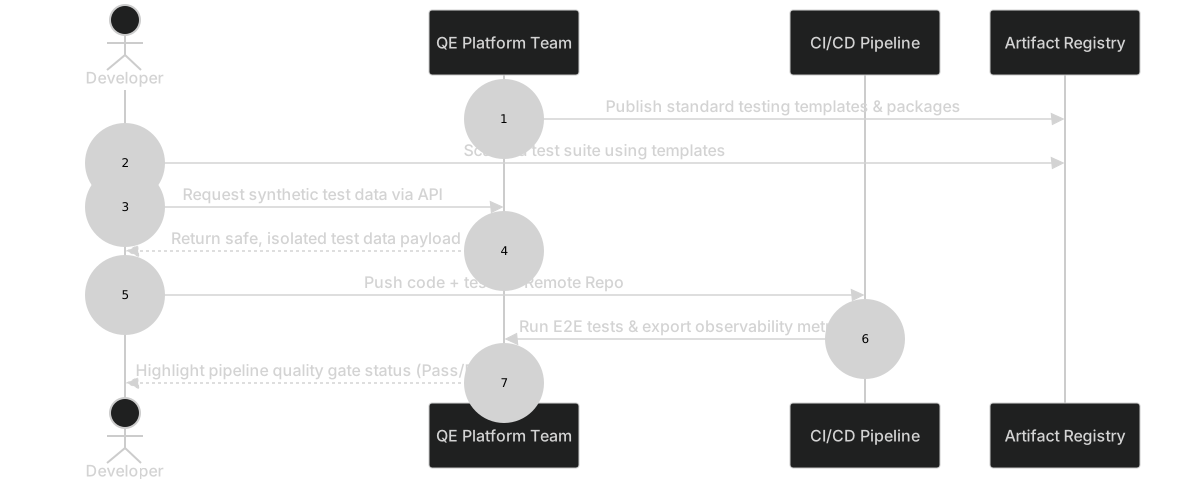
4. Platform Consumption Flow
This diagram illustrates how developers consume self-service testing templates and data, while the QE team manages the underlying platform and gathers observability metrics.
5. Reusable Azure DevOps Quality Gate Template
The following YAML snippet demonstrates a reusable pipeline template provided by the QE Platform Team. Product developers import this template into their main application pipelines to run containerised Playwright tests and publish results automatically.
# templates/qe-playwright-quality-gate.yml
parameters:
  - name: testDirectory
    type: string
    default: 'tests/e2e'
  - name: nodeVersion
    type: string
    default: '18.x'

jobs:
  - job: RunPlaywrightTests
    displayName: 'Execute Playwright Quality Gate'
    pool:
      vmImage: 'ubuntu-latest'
    steps:
      - task: NodeTool@0
        inputs:
          versionSource: 'spec'
          versionSpec: ${{ parameters.nodeVersion }}
        displayName: 'Install Node.js'

      - script: |
          npm ci
          npx playwright install --with-deps
        displayName: 'Install Dependencies and Browsers'

      - script: |
          npx playwright test ${{ parameters.testDirectory }} --reporter=html
        displayName: 'Run E2E Tests'
        env:
          CI: 'true'

      - task: PublishHtmlReport@1
        condition: always()
        inputs:
          htmlPath: 'playwright-report'
          title: 'Playwright E2E Execution Report'
        displayName: 'Publish Quality Gate Report'
6. Success Metrics & KPIs
To measure the success of the transition from traditional QA to the QEaaS model, we track key indicators of autonomy and delivery health:
- Test Autonomy Rate: The percentage of code commits in E2E repositories authored by Product Developers rather than QE. Target:
> 80%within 6 months. - Lead Time for Changes: The time it takes for a commit to go from code review to production. By shifting quality gates left and automating E2E verification, this should drop significantly.
- Change Failure Rate: The percentage of deployments that cause a failure in production. In a healthy QEaaS model, this remains low because automated gates catch defects before release.
- Flakiness Resolution MTTR: The average time it takes for the team to identify, quarantine, and resolve a flaky test in the pipeline.